
PURE ENERGY
BALANCE™
The body doesn't run on a calorie ledger. It runs on a biochemical system — one where skeletal muscle is the primary engine of energy regulation, not a side effect of exercise.
The Framework at a Glance
THE MAXQ EQUATION
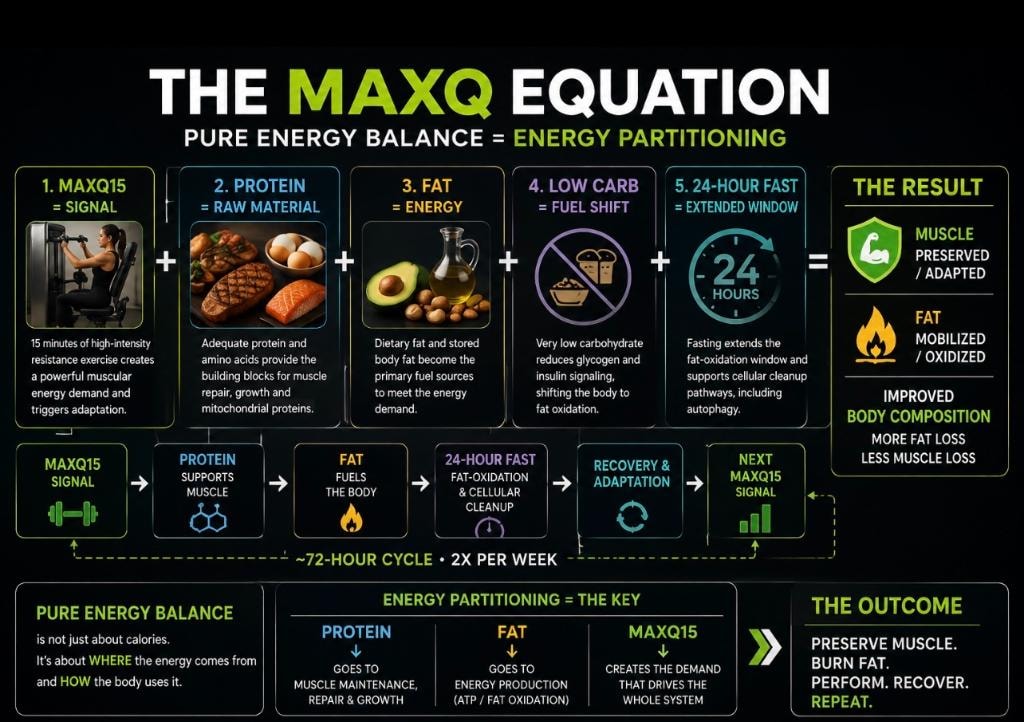
The Fundamental Question
WHERE DOES
THE ENERGY GO?
Every model of weight management starts with the same assumption: energy in minus energy out equals body weight change. But that equation ignores the most important variable — where the energy actually goes inside the body.
Calories don't tell you whether energy is being stored as fat, burned by muscle, used to rebuild tissue, or lost as heat. The body's energy routing is determined by its biochemical state — and skeletal muscle is the primary router.
Three Competing Frameworks
HOW EACH MODEL
EXPLAINS ENERGY
CALORIC
BALANCE
Energy in minus energy out equals weight change. Eat less, move more. All calories are equal.
The Gap
Ignores hormonal signaling, metabolic adaptation, and where energy is actually routed inside the body.
CARB-INSULIN
MODEL
Carbohydrates drive insulin, which drives fat storage. Reduce carbs, lower insulin, unlock fat burning.
The Gap
Addresses one hormone but underweights the role of skeletal muscle as the primary site of glucose disposal and energy demand.
PURE ENERGY
BALANCE™
Skeletal muscle is the primary engine of energy regulation. Build and maintain muscle quality, and the body's energy routing system works as designed.
The Difference
Addresses the full system: mechanical demand, ATP production, mitochondrial density, insulin sensitivity, and lipolysis — all driven by muscle quality.
The System
THE PURE ENERGY
BALANCE LOOP
Three stages. One continuous cycle. Each stage feeds the next — and muscle quality is the engine that keeps it running.
Tap a stage to explore
MECHANICAL DEMAND
A precise mechanical stimulus — algorithmically controlled resistance — creates the signal that initiates the entire energy cascade. Without the right stimulus, the loop never starts.
ATP PRODUCTION
Efficient muscle contractions trigger high-yield ATP synthesis via the oxidative phosphorylation pathway — producing up to 32 ATP per glucose molecule vs. 2 via glycolysis.
MUSCLE RESPONSE
Muscle fiber breakdown triggers protein synthesis, mitochondrial biogenesis, and improved insulin sensitivity — increasing the body's capacity to route energy into muscle rather than fat storage.
Each cycle builds on the last. Muscle quality improves → energy routing improves → body composition improves.
Where It Applies
THE PURE ENERGY
BALANCE PLATFORM
Pure Energy Balance™ is not just a fitness concept. It's a framework with applications across the full spectrum of metabolic health.
Body Composition
Simultaneous muscle gain and fat loss — not sequential. Driven by the mechanical stimulus that initiates the energy cascade, not caloric restriction.
Metabolic Health
Improved insulin sensitivity, balanced glucose uptake, and reduced inflammatory signaling — all downstream effects of increased skeletal muscle quality.
GLP-1 Augmentation
GLP-1 medications reduce appetite and promote weight loss — but without muscle stimulus, a significant portion of that loss is lean tissue. MaxQ15 reverses that equation.
Longevity & Aging
Sarcopenia — age-related muscle loss — is the primary driver of metabolic decline. Maintaining muscle quality is the most evidence-backed intervention for healthy aging.
Performance
Greater ATP production capacity, improved mitochondrial density, and faster recovery — the same biochemical adaptations that improve body composition also improve performance.
The Core Idea
MUSCLE IS MORE THAN
SOMETHING TO PRESERVE.
Muscle as a metabolic organ
Skeletal muscle is the largest insulin-sensitive tissue in the body. It accounts for up to 80% of insulin-stimulated glucose uptake. When muscle quality declines, so does the body's ability to manage blood sugar — regardless of diet.
Muscle as an energy router
The quality of your skeletal muscle determines where energy goes. High-quality muscle with dense mitochondria routes energy into ATP production and tissue repair. Low-quality muscle routes it into fat storage and inflammatory pathways.
Muscle as a signaling system
Muscle contractions release myokines — signaling molecules that communicate with fat tissue, the liver, the brain, and the immune system. The mechanical stimulus of exercise is, at its core, a biochemical signal.
Muscle as the intervention
If muscle quality is the primary determinant of metabolic health, then the most effective intervention is the one that most precisely and efficiently improves muscle quality. That's the design principle behind MaxQ15.
15+
Years of research
60,000+
One-on-one sessions
2,000+
Data points collected
Longitudinal
Body comp tracking
The MaxQ15 Position
ENERGY IS NOT
THE ENEMY.
The problem isn't that you have too much energy. The problem is that your body doesn't have the muscle quality to use it correctly.
MaxQ15 is built on one idea: give the body the precise mechanical stimulus it needs to build and maintain the muscle that makes energy balance work — in 15 minutes, twice a week.
Experience MaxQ15™